Equal Time Parenting Arrangements in Australia: A Practical Guide for Separated Parents
Understanding 50/50 Care, Parenting Schedules and Shared Custody Options
Wallen Family Law – Parenting & Custody Lawyers in Wollongong and greater Sydney
When parents separate, one of the most common questions is whether equal time (sometimes called 50/50 care or shared custody) is appropriate for their children. Equal time works well for many families, but it needs to be structured carefully to ensure stability, routine, and consistency.
At Wallen Family Law, we help parents design practical and child-focused equal-time arrangements. Below are two of the most common calendars we use across our parenting family law matters for equal time parenting matters, as alternative options for a week on-week off care arrangement.
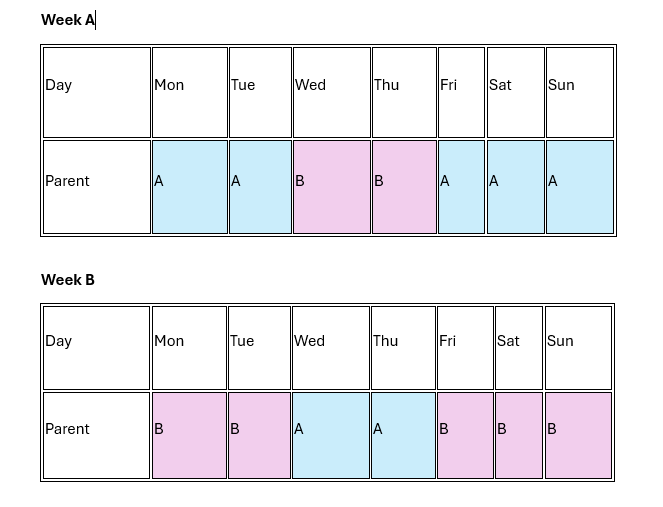
Option 1: 2–2–3 Equal Time Rotation (Alternating Fortnights)
A structured and predictable equal-time arrangement for school-aged children
The 2–2–3 rotation allows children to spend consistent time with each parent across a two-week cycle. It works particularly well for families who live close to each other and want predictable weekday routines.
Benefits of a 2–2–3 Parenting Arrangement
✔ Predictable weekday schedule
✔ Alternating weekends for both parents
✔ Shorter stretches between seeing each parent which is usually suitable for younger children
✔ Helpful for children who may have a strong attachment to one or both parents
✔ Easy to implement alongside extracurricular activities
Potential Downsides
More changeovers each week
May not suit families who live further apart
Not ideal for high-conflict parenting situations
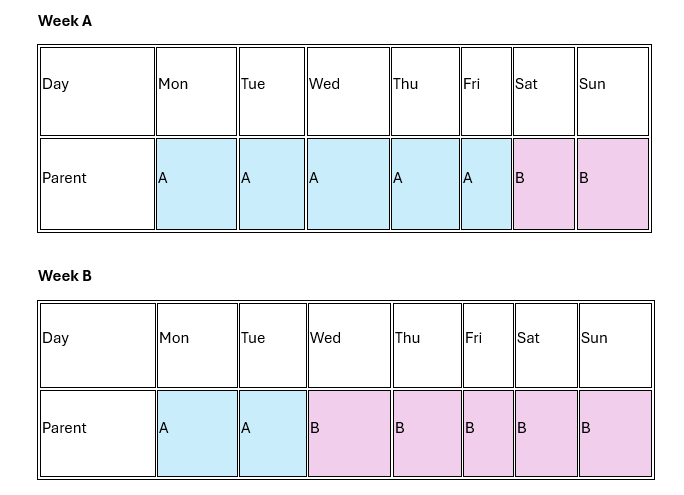
Option 2: 5–2 / 2–5 Equal Time Split (Fortnight Cycle)
Longer blocks of time with fewer transitions
The 5–2 / 2–5 schedule gives each parent longer periods of care. This structure is often preferred for older children or busy families with demanding school schedules.
Benefits of a 5–2 / 2–5 Schedule
✔ Fewer weekly transitions
✔ Clearer routine for school days
✔ Greater stability for homework, sport and after-school commitments
✔ Particularly suitable for older school-aged children
✔ Often works well when the parents live further apart
Potential Downsides
One parent manages the majority of weekday routines each fortnight
Children may go longer stretches without seeing one parent
Which Equal Time Parenting Schedule Is Best?
There is no one right answer. At Wallen Family Law, we help parents design schedules based on:
✔ Children’s ages and attachment needs
Young children may need more frequent transitions, while older children might thrive with longer blocks of time.
✔ Distance between homes
More distance = fewer handovers.
✔ Each parent's work schedule
Shift work and rotating rosters may make some models unrealistic.
✔ Parenting communication
High-conflict separations often require simpler, low-transition arrangements.
✔ School, therapy and activity schedules
Some families need one parent to manage consistent weekday activities.
If equal time is not workable, parents can still consider substantial and significant time, which ensures frequent weekday and weekend time without requiring a strict 50/50 split.
Equal Time and the Family Court: What You Need to Know
The Court does not automatically order equal time, and it is not presumed to be in the child’s best interests. Instead, the Court examines:
the needs of the child, age and attachment to both parents
safety and risk issues
stability of the home environment
how each parent has participated in the child’s daily care
whether the arrangement is practical in real life
Our role is to help you assess whether equal time is appropriate for your family and, if so, design a schedule that best supports the children.
Frequently Asked Questions
Is 50/50 custody common in Australia?
Equal time is common where parents communicate well, live close to each other, and the arrangement supports the children’s needs. It is not automatically ordered.
Do judges prefer 50/50 care?
No. The Family Court focuses on the child’s best interests — not a numerical split.
Is equal time better for children?
It depends on the child’s age, developmental needs, routine, and the practical realities of each household.
Can equal time work if parents don’t get along?
High conflict may make equal time impractical, especially when frequent transitions are required.
What is the best equal-time parenting schedule?
The 2–2–3 and 5–2 / 2–5 structures are the most common for younger children. The best option depends on your child and your family’s circumstances.
Need Advice About Equal Time Parenting?
Wallen Family Law helps families across Wollongong, the Illawarra, South Sydney and The Hills create parenting arrangements that are clear, workable and child-focused. Whether you are negotiating privately, attending mediation, or involved in Court proceedings, we can guide you through the options.
Disclaimer: This article provides general information only and should not be relied upon as legal advice. Every family law matter is unique and requires specific legal guidance. Always seek professional legal advice for your specific situation.